

Cancer remains a leading cause of death worldwide, placing significant economic and social pressure on healthcare systems. According to the World Health Organization (2024), there were approximately 20 million new cancer cases and 9.7 million deaths in 2022, while the American Cancer Society (2026) estimates about 2.1 million new cases in the United States. These figures highlight the urgent need for more effective, targeted therapies and early interventions to improve survival rates.
Chemotherapy, which relies on cytotoxic agents, remains a cornerstone of cancer treatment due to its strong anti-tumor effects. The concept of selectively targeting diseased cells was first proposed by Paul Ehrlich in 1913 as the “magic bullet” theory. However, chemotherapy is often limited by poor specificity, a narrow therapeutic window, and the development of drug resistance. Achieving precise tumour targeting while reducing systemic toxicity continues to be a major challenge.
To address these limitations, research has focused on therapies with greater selectivity and reduced side effects. Monoclonal antibodies (mAbs) have emerged as effective targeted treatments, with over 160 approved by 2025 and around 42% used in oncology. Despite their specificity, mAbs often lack strong cytotoxic activity and can still encounter resistance.
Antibody–drug conjugates (ADCs) have therefore emerged as a promising alternative, combining the targeting ability of mAbs with potent cytotoxic drugs. ADCs consist of an antibody linked to a cytotoxic payload via a chemical linker. They selectively bind to specific antigens on target cells, are internalized, and release active metabolites that induce cell death, thereby improving efficacy while minimizing systemic toxicity.
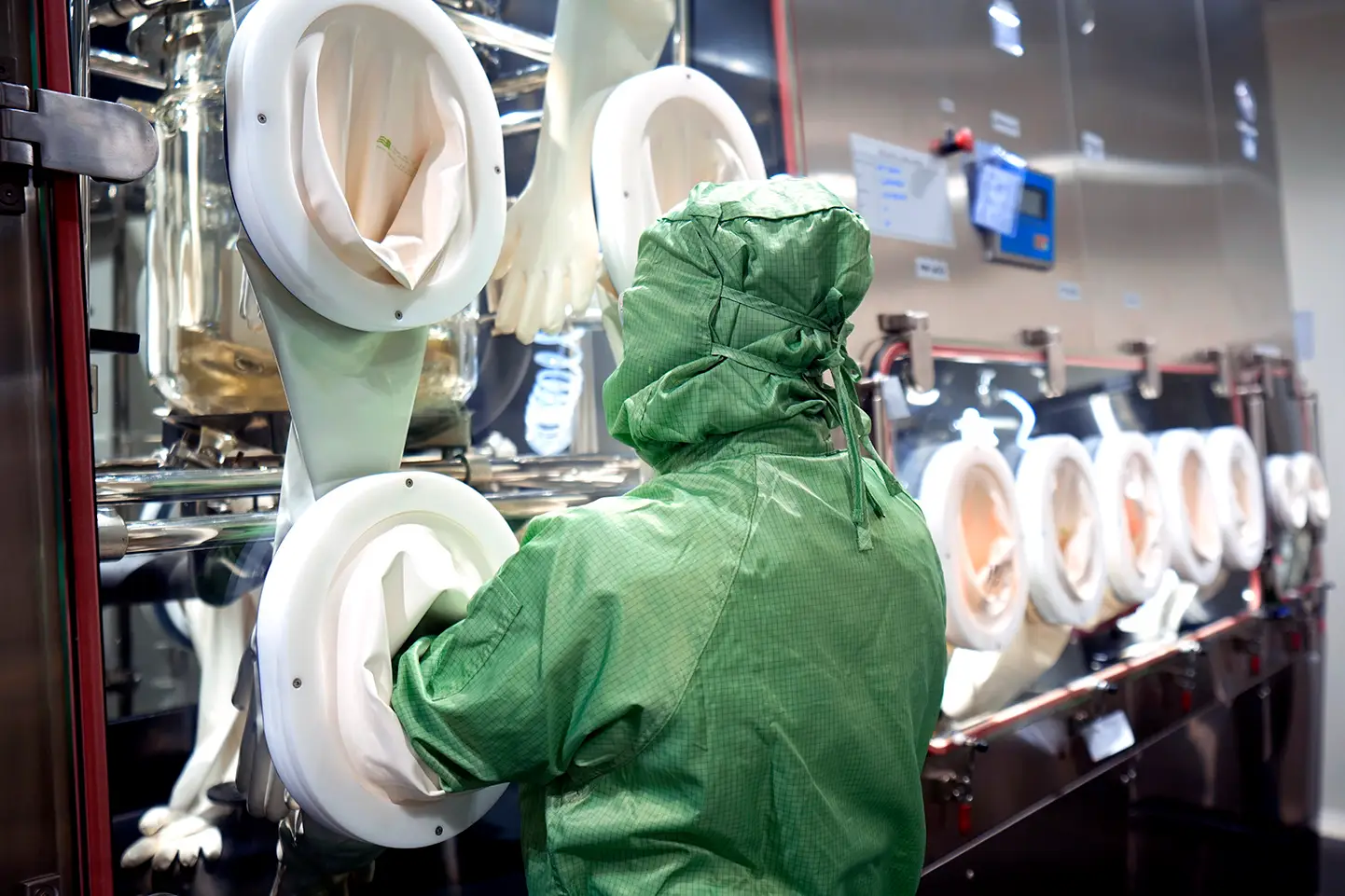
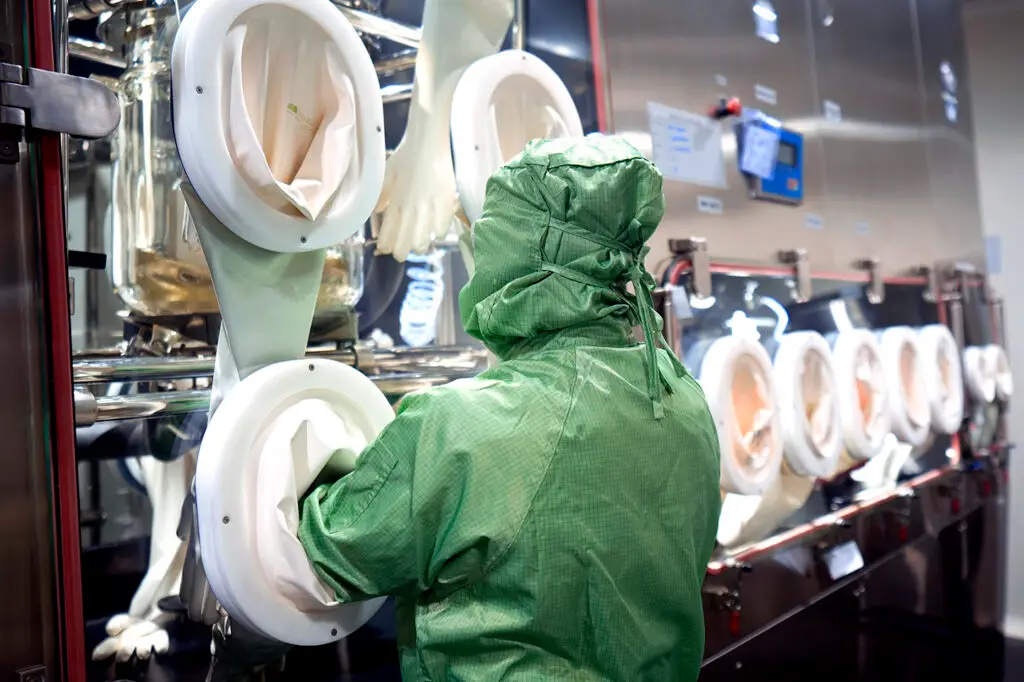
The development and manufacturing of antibody–drug conjugates (ADCs) are highly complex process. They require the integration of a monoclonal antibody (mAb), linker and a cytotoxic payload, which must be chemically conjugated and then formulated into the final drug product. Due to the potent toxicity of the payloads, many steps must be conducted in high-containment facilities, adding further logistical and safety challenges.
Despite these complexities, ADC projects offer a unique opportunity for collaboration between scientists specializing in biologics (mAbs) and those focused on synthetic chemistry (payloads and linkers). The development and scale-up of the mAbs, payloads and linkers present significant, yet exciting, challenges for protein science and process scientists.
Most payloads used in approved ADCs are derived from natural products and possess high molecular complexity, resulting in lengthy and intricate synthetic pathways. The payloads of currently FDA-approved antibody-drug conjugates (ADCs) primarily fall into three categories: anti-mitotic agents such as auristatins (e.g., MMAE, MMAF, maytansinoid derivatives such as DM1, DM4), DNA-damaging agents including calicheamicins and pyrrolobenzodiazepine (PBD) dimers, and topoisomerase inhibitors such as DXd and SN-38.
The linker is a vital component of antibody-drug conjugates (ADCs), responsible for precisely attaching cytotoxic payloads to monoclonal antibodies (mAbs). Its design plays a critical role in ensuring targeted drug delivery and optimizing therapeutic efficacy. An ideal linker design must exhibit high stability in systemic circulation, maintaining a secure bond between the antibody and the payload. This stability minimizes premature drug release and reduces off-target toxicity, thereby enhancing the safety and effectiveness of the ADC. Linkers have been categorized into two types – cleavable and non-cleavable.
Diverse types of antibodies are being explored, however, humanized and fully human IgGs are commonly utilized as ADC backbone. Monoclonal antibodies with high specificity for tumor-associated antigens (TAAs) expressed on the surface of malignant cells serve as optimal target moieties for the development of antibody-drug conjugates (ADCs), facilitating selective intracellular delivery of cytotoxic payloads to neoplastic tissues while minimizing off-target effect.
1. The Bottleneck in Payload-Linker Chemistry
The therapeutic efficacy of Antibody–Drug Conjugates (ADCs) depends on precise control of chemical purity, stability, and drug-to-antibody ratio (DAR), placing significant emphasis on payload design and manufacturability. However, widely used natural product–derived payloads, such as Camptothecin (CPT) and Auristatin analogues, present substantial synthetic challenges.
These molecules exhibit high structural complexity, with multiple stereocenters and functionalized frameworks, leading to long multi-step syntheses (>15–20 steps) and low overall yields. A robust control strategy is required to maintain stereochemical integrity and reduce process variability. Functional group instability further complicates synthesis and handling. For instance, CPT lactone rings are prone to hydrolysis, while Auristatins contain peptide-like linkages susceptible to degradation and epimerization. These sensitivities restrict reaction conditions and reduce process robustness.
In addition, unstable intermediates, poor solubility, and reliance on chromatographic purification hinder scalability and batch reproducibility. Manufacturing challenges are compounded during scale-up, where reaction control, safety, and availability of specialized reagents affect cost of goods and supply reliability.
Payload design must also accommodate linker conjugation without compromising potency, often requiring additional synthetic modifications. Furthermore, susceptibility to efflux-mediated multidrug resistance (MDR) drives further structural optimization, adding complexity to already demanding synthetic routes.
Cohance, provides a fully backward-integrated platform designed to solve these upstream scaling and conjugation bottlenecks from gram to multi-ton scale.
2. Platform Core Competencies & Chemical Engineering
2.1 The Camptothecin (CPT) Platform & the S-Trione scaffold
Topoisomerase I inhibitors (such as SN-38 and Exatecan) selectively induce cancer cell death by stabilizing Topoisomerase I–DNA complexes, blocking DNA repair, disrupting replication, and ultimately triggering apoptosis.
The structural modification of core scaffold is often constrained by process feasibility and the need to maintain stereochemical integrity.
[S-Trione Intermediate] ──> (Proprietary Synthetic Route) ──> [Diverse CPT Derivatives / Exatecan / SN-38]
- Proprietary S-Trione Scaffold : Cohance utilizes our proprietary (s)-Trione intermediate (US DMF 039042) as a versatile core scaffold. This technology enables efficient, scalable modification of the camptothecin core without sacrificing stereo-centers.
- Library and Scale : Access to over 2,000 custom CPT derivatives tailored to specific linker compatibilities and target cytotoxicity profiles.
- Active DMF Support : Fully audited manufacturing facilities with active US DMFs for S-Trione, Camptothecin, Irinotecan, SN-38, and Exatecan, along with upcoming filings for Topotecan and Belotecan
2.2 Technology Driven Process Development
Cohance has built a strong platform around payloads targeting topoisomerase (Camptothecin derivatives) and tubulin inhibitors (MMAE and its derivatives). The team leverages AI-enabled tools for efficient route scouting, predictive reaction optimization, and impurity profiling, complemented by a Quality by Design (QbD) framework to ensure robust and scalable process development. Additionally, advanced Design of Experiments (DoE) methodologies are systematically applied to map process parameters, define design spaces, and enhance process robustness. Integration of data-driven modeling and machine learning further supports kinetic understanding, yield improvement, and control strategy development, enabling efficient scale-up while maintaining consistency, quality, and cost-effectiveness.
A systematic control strategy is implemented to effectively manage impurities, supported by highly sensitive and advanced analytical methods for comprehensive characterization and cleaning validation. These capabilities are further strengthened by a well-established quality management system, ensuring consistency, reliability, and uninterrupted supply of high-quality materials.
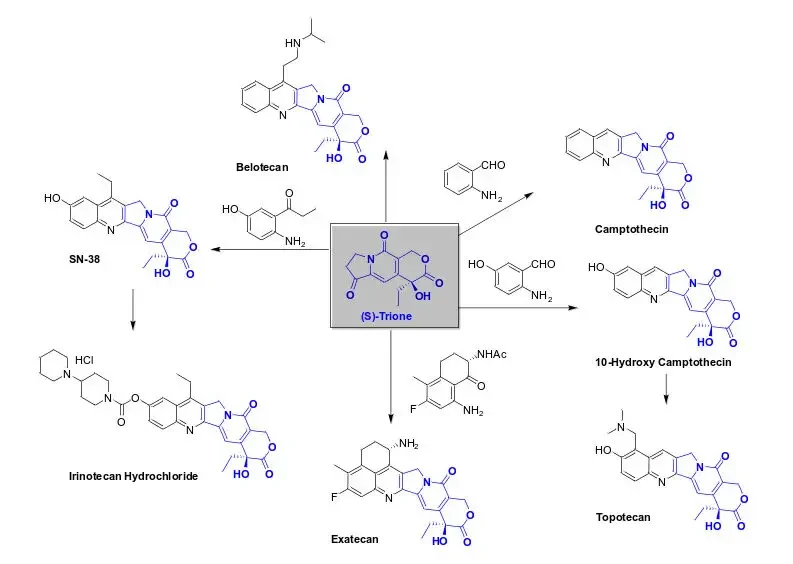 Camptothecin Platform

MMAE derivatives
Comprehensive safety and quality frameworks have been established to support the handling of high-potency compounds, with emphasis on rigorous containment and risk mitigation. The infrastructure is designed to enable reliable scale-up from laboratory development to commercial manufacturing for OEB-4 to OEB-6 molecules. These systems are underpinned by advanced engineering controls, including closed processing, dedicated containment equipment, and facility design aligned with global regulatory expectations.
Back-integrated Linker Payloads
| Product | DMF/CEP | Manufacturing Scale |
| S-Trione | 039042 | Gram to Multi-Ton |
| SN-38 | 039031 | Gram to multi-Kilogram |
| Exatecan | 043412 | Gram to multi-Kilogram |
| Camptothecin | 043966 | Gram to multi-Kilogram |
| Irinotecan Hydrochloride Trihydrate | 043677/ CEP 2023-338 | Gram to multi-Kilogram |
| MMAE (Auristatin) | DMF in Aug’26 | Gram to multi-Kilogram |
| Linkers: Standard & Novel | — | Gram to multi-Kilogram |
| Novel Topoisomerase I and Auristatins | — | Gram to multi-Kilogram |

Chief Operating Officer
Cohance Lifesciences